
Where FITTER Forward fits in the history
FITTER Forward is the latest chapter in a long history of diabetes experts collaborating to improve insulin injection practices of both healthcare practitioners (HCPs) and people with diabetes. FITTER Forward members convened virtually in 2023-24 to update injection technique recommendations published in 2016 by the original FITTER group. Below we capture key initiatives in the development of insulin delivery recommendations; regional recommendations have also emerged over the years which further support the mission of advancing insulin delivery.
History
syringe
Technique
Questionnaire
(ITQ) Workshop
Workshop
Workshop
(TITAN)
ITQ Workshop

- Insulin has been a mainstay of care for people living with diabetes since the first insulin syringe in 1924
- As insulin delivery technology has evolved, diabetes care experts have met regularly to create evidence-based injection technique recommendations
- The Forum for Injection Technique Expert Recommendations (FITTER) established global injection technique guidance in 2016.
- FITTER Forward, published in 2025, built upon this legacy through updated recommendations on injection technique, lipohypertrophy risk reduction, and structured education.
- FITTER BiG explores barriers, insights, and opportunities to improve blood glucose monitoring best practices and support better outcomes for people using injectable therapies.
- FITTER Lipo highlights strategies to prevent, identify, and manage injection-site complications that can impact medication absorption and glycemic outcomes.
- FITTER Youth modifies adult injection technique recommendations from FITTER Forward for the distinct requirements of pediatric, adolescent, and young adult diabetes management.
October 2026: FITTER Youth
FITTER Youth presents updated, consensus based recommendations on insulin injection technique and education for children, adolescents, and young adults with diabetes.
- These recommendations address the physiological, developmental, and psychosocial factors that uniquely influence insulin use across early life stages.
- FITTER Youth provides age stratified guidance on device selection, injection technique, site rotation, insulin storage, and lipodystrophy prevention, while emphasizing education for caregivers, schools, and community care providers.

September 2026: FITTER Lipo
Consensus Recommendations on Lipohypertrophy provides evidence informed consensus recommendations for screening, prevention, and management of this common but underrecognized complication of insulin therapy.
- Developed through a modified Delphi process with 13 international experts, these recommendations address clinical practice gaps that contribute to glycemic variability, increased insulin requirements, and higher healthcare costs.
- Emphasis is placed on standardized injection site examination, systematic site rotation, appropriate needle use, and education for clinicians and PwD, with the goal to support consistent, optimal insulin administration across care settings.

May 2025: FITTER BiG
Blood Glucose Monitoring Expert Group and Best Practice Recommendation—FITTER BiG: This manuscript provides consensus-based recommendations for blood glucose monitoring (BGM), developed through a targeted literature review and a structured expert forum involving 7 experts from seven countries. Despite its critical role in diabetes management, BGM remains underutilized and susceptible to technique-related errors, reflecting practice gaps previously documented in insulin injection. The recommendations propose pragmatic, context-specific strategies that address clinical decision-making, patient engagement, technology integration, and policy shaping. The aim is to optimize BGM practices and improve outcomes for people living with diabetes in resource-diverse settings.
more
2025: FITTER Forward
The FITTER Forward initiative included 16 diabetes specialists from 13 countries who met during 4 virtual sessions from September 26, 2023, to June 28, 2024. The FITTER Forward recommendations, published in 2025, revise prior recommendations and share new insights on injection education program design. FITTER Forward highlights the measurable value of proper insulin delivery technique for improving clinical outcomes and reducing unwanted adverse effects.
more
2016: FITTER
The FITTER group consisted of 183 diabetes experts from 54 countries, and their recommendations were informed by literature review and the fourth ITQ survey of 13,289 insulin-injecting people with diabetes. The 2016 FITTER recommendations are currently cited in the 2024 ADA Standards of Care as best practices for insulin injection. New to this set of recommendations was mention of insulin infusion and coverage of key studies since TITAN.
more
2009: TITAN
The Third Injection Technique workshop in AtheNs (TITAN) was held in 2009 in Athens, Greece, where 127 experts from around the world discussed injection practice among people treated with insulin and/or GLP-1 agents. Injection recommendations based on systematic literature review, survey of people with diabetes, and experts’ collective experience were established by the TITAN group. New to this iteration of recommendations was discussion of insulin analogues (rapid- and long-acting), GLP-1 agents, pregnancy, and safety needles. Another ITQ , this time with 4,352 insulin-injection people with diabetes, provided key background for TITAN.
more
2000: SITE
The Second Injection Technique Event (SITE) was held in Barcelona in 2000 with over 90 attendees. The ‘shift to short’ needle lengths was a key change that emerged from this session, and nurses and diabetes educators were included for the first time for a more comprehensive discussion. The second ITQ was held during this time.
view site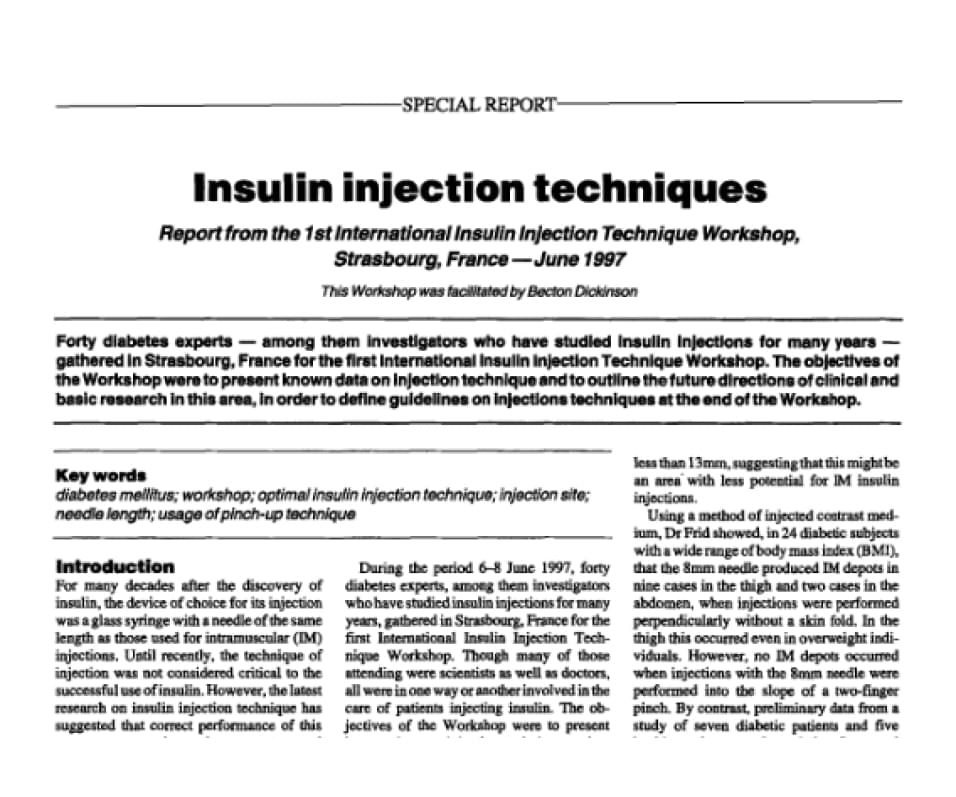
1997
The first Insulin Injection Technique Workshop occurred in Strasbourg in 1997, and included 40 endocrinologists and injection experts from around the world. This work advanced diabetes care by setting the first evidence-based best practices for insulin injection and was informed by the first Injection Technique Questionnaire (ITQ) surveying people with diabetes regarding injection practices.
view report